
HAMNET AND WEOBLEY
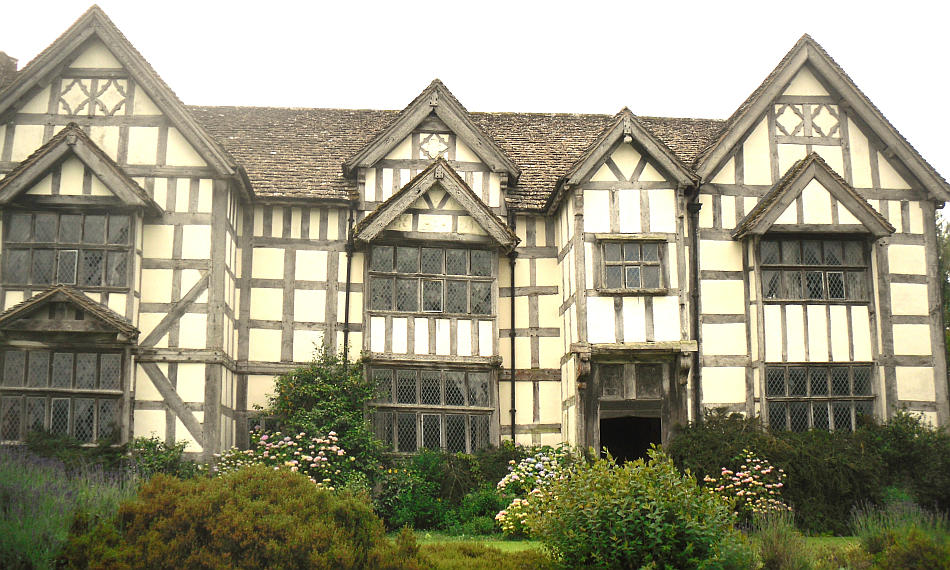
The image at the top of the page shows The Ley which dates from Shakespeare's time.
THE OSCARS
IT probably hasn’t been every day of the week that a sleepy north-western corner of Herefordshire has been associated with Hollywood and the Oscars but all of this changed when Irish girl Maggie O'Farrell’s award-winning novel Hamnet came to town. The delightful work, adapted for film with sensational results, is a fictional account of the lives of William Shakespeare and his wife Agnes. It delves into how the death of their son could have influenced one of the writer's most enduring masterpieces, Hamlet. For it was Weobley in the old Welsh Marches, some sixty miles west of Shakespeare’s famous home in Stratford-Upon-Avon, that was chosen as the filming location for many scenes in the film. The production, specifically, was suitably based around Broad Street, Bell Square and Church Road in Weobley for several months, capturing O'Farrell's take on the playwright's early years.
Many of the black and white buildings are from the late 15th and early 16th century and the landscape nearby is described by Visit Herefordshire as "bucolic" and "Shakespearean", so visitors don't have to stretch their imagination too much to immerse themselves in the movie’s world. There is certainly more than a passing resemblance to the days of 1596 in which the film is set.
So, the accolades were showered on Hamnet at the 98th Academy Awards on March 15, 2026, with Jessie Buckley winning Best Actress for her role as Agnes. Altogether, the film received a total of eight nominations, including Chloé Zhao for Best Picture and Director.
ELLA MARY LEATHER and RALPH VAUGHAN-WILLIAMS
SOME years before the modern luminaries came to Weobley, the picturesque village had its own contributor to our literary archive. Born in Dilwyn just two miles away, Ella Mary Leather lived at Castle House on the Hereford Road in Weobley with her husband Francis Holdsworth Leather, a solicitor. In 1912 Mrs. Leather authored the seminal work entitled The Folklore of Herefordshire, in which she weaves together a rich fund of tales and songs collected from local singers and travelling gypsies; she passed her days scouring the neighbourhood for purveyors of folklore and her niece Nona Swire later recalled that “Ella would take me round in the dog-cart to visit the old folk where she had heard folk songs.” These researches are still a source of much local pride.
Frequently to be found in Mrs. Leather’s company was a rhapsodist more noted on the national stage. The composer Ralph Vaughan-Williams was an early student of British folk-song; he came to Herefordshire to collect tunes from the other black and white villages of Pembridge and Eardisley as well as Weobley where he met Mrs. Leather for the first time in 1908. By the time he had made several more visits to the scene, the composer had collaborated with her to publish the Twelve Traditional Carols from Herefordshire in 1920. It is generally thought that Mrs. Leather, who had taken possession of a phonograph, noted the words and Vaughan-Williams the tunes. For clarity of purpose Mrs. Leather eschewed the class convention of the day to join up with hop-picking Gypsies to collect the wealth of her material. Vaughan-Williams, no stranger, by the way, to the hospitality of The Salutation Inn in the village, provided the musical arrangement.
By the 1930s, Ralph Vaughan-Williams had become The Grand Old Man of his country’s music, inspiring generations with his conviction that “the composer must not shut himself up and think about art; he must live with his fellows and make his art an expression of the whole life of the community.” His most famous work The Lark Ascending was inspired by a poem of the same name written by George Meredith; he was working on this as early as 1914, shortly before the outbreak of World War I. Now considered a masterpiece, it evokes the soaring flight of a lark, singing an impossibly beautiful, almost heavenly song and symbolizes peace and freedom.
ON THE FOLKLORE TRAIL
I was once told by a Weobley man, Mrs. Leather asserts, that he had gone to assist a policeman trying to arrest the drunken son of a local witch: “I helped him and didn’t think. My missis said when I came home I’d be sorry for it. Sure enough, my pig died next week.”
Such is the sort of pearl of wisdom that Mrs. Leather unearthed. We can still get a flavour for her heartland by following my suggested trail from Bell Square in Weobley. We pass her old home, become attuned with more aphorisms and strike up fields redolent of that enduring lark’s domain.
“LEATHERBOUND” - Weobley, Garnstone, Fenhampton and The Ley.
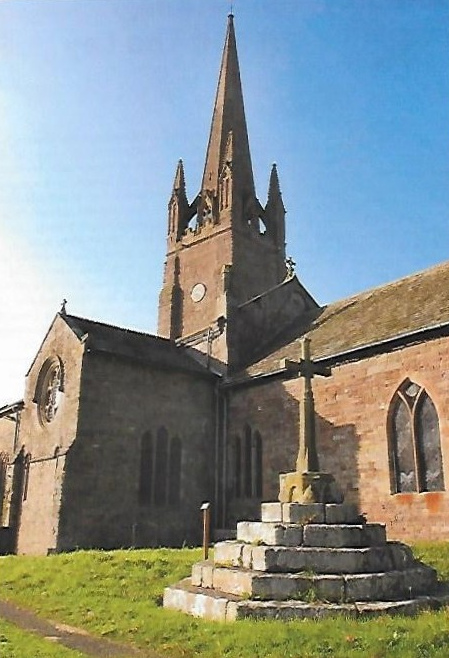
WHEN leaving Bell Square in Weobley at the start of an unexacting walk, be sure to look up at the second tallest church spire in the county.
Don't forget to recite The Lord's Prayer - backwards
If there are jackdaws fluttering around it, take your waterproofs. Provided that you have slept with an old LEFT stocking around your neck, the sore throat you had yesterday will have gone already. If, like Colonel John Birch’s old commanding officer Oliver Cromwell, you’ve got warts, it won’t do any harm at all if you manage to catch a live mole: make its nose bleed and cross the blemishes nine times with a finger dipped in its blood.
Birch lies in Weobley Church where he arranged for a marble statue of himself to be constructed in full military gear to extol his Parliamentary service under his blemished commanding officer.
“The Throne” in Weobley’s Hereford Road, formerly The Crowne Inn, was the hostelry which provided their bête noir Charles I with board and lodging in 1645. On the other side of the street the stone-built Castle House became the home of Ella Mary Leather until her death in 1928. It was here that Mrs. Leather learned folk songs from gipsies whilst entertaining them on the back lawn with cocoa and buns.
Observing that there was no systematic record of old local country customs she published her compilation in 1912, as we have said, The Folklore of Herefordshire.
One of the main sources of her inspiration was old Will Colcombe who had died the year before in Weobley Workhouse (see map for its old location.) Will knew more than thirty traditional songs and carols, and lots of old tales and riddles. Remembered as the last local man to wear a smock-frock, other, perhaps, than to one of the pubs on a Saturday, he in turn had picked up many of these from “Old Powell”, the nailmaker.
There is an information board at the northern entrance to the first castle site on our route. Originally built by the De Lacys in the twelfth century, and re-built after 1216, it played no part in the civil strife between Charles and parliament. The antiquarian, John Leland, recorded in about 1535, “Weobley is a market towne in Herefordshire, where is a goodly castell, but somewhat in decay”.
The second castle was on the Garnstone Estate, purchased as a mansion by Birch in 1661, and improved during his time as a Weobley MP and country squire.
It was re-built as a castle by John Nash in 1807, but his biographer commented that it was the worst piece of architecture he ever did. Though it was at the hub of village life in the first half of the 1900s, it became too expensive to maintain and was pulled down in 1958.
Walking with good views from the upper estate we wonder if there is still a snuff-box lying at the bottom of the old pond. The saying goes that it supposedly contains the spirit of a farmer who committed suicide at neighbouring Fields’ End.
Via the quiet Fenhampton Farm Lane we come to a rewarding surprise eventually in the shape of the charming eight-gabled farmhouse, The Ley. Built by James Brydges in 1589 when Shakespeare was 25, it is an imposing, silver-grey timber-framed paragon of Elizabethan architecture.
After re-establishing contact with the church spire, a faithful friend for walking Weobley, it’s probably best to get back before midnight. If we don’t there may be some dubious types about summoning the devil by walking seven times slowly around the Preaching Cross, reciting the Lord’s Prayer backwards.
If one of the party has sprained an ankle getting over one of the stiles on our route, the advice is to limp home and repeat Ezekiel chapter 37, verses 6, 7 and 8, nine times – but inaudibly.
Downloading the walk
This walk can be downloaded below as a pdf from the relevant page. It is free, but in exchange we would ask for a donation to St Michael's Hospice, near Hereford. How much you choose to donate is entirely up to you.